Favia Investment Group | Market Insights
LA City Slashes Allowable Rent Increases: What Your RSO Units Will Earn in 2026-2027
By Don Favia | February 20, 2026
https://www.faviainvestmentgroup.com/market-insights/la-city-slashes-rso-rent-increases
This is for general informational purposes only. Consult with your CPA, tax advisor, and/or attorney for guidance specific to your situation. Market data reflects conditions as of early 2026.
If you own rent stabilized apartment buildings in Los Angeles, you need to know about a major change that just went into effect. The LA City Council voted in December 2025 to significantly reduce the maximum allowable rent increase for RSO covered units. The new rules took effect January 24, 2026, with the revised formula kicking in on July 1.
Here's what changed, what it means for your income, and what you can still do about it.
For a complete breakdown of how LA rent stabilization works, see our LA rent control guide.
What the City Council Changed
The old formula allowed landlords to raise rents by up to 8% annually on RSO units. That cap just dropped to 4%.
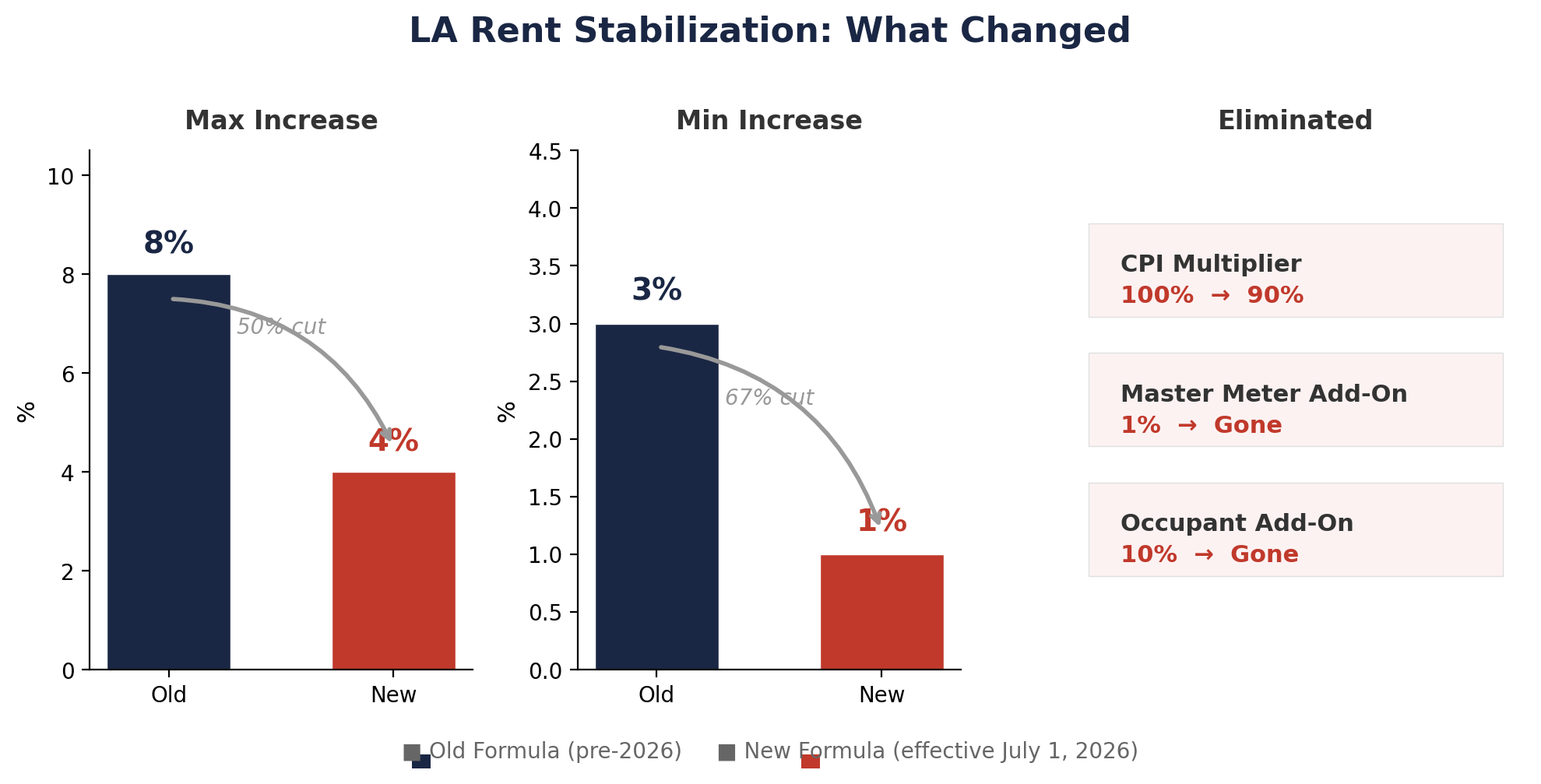
Here's the breakdown:
Old formula:
- Based on 100% of the LA area Consumer Price Index (CPI)
- Maximum allowable increase: 8%
- Minimum increase: 3%
- Additional 1% for master metered gas or electric
- Additional 10% for each additional occupant beyond the number on the original lease
New formula (effective July 1, 2026):
- Based on 90% of CPI (down from 100%)
- Maximum allowable increase: 4% (down from 8%)
- Minimum increase: 1% (down from 3%)
- Master metered add-on: eliminated
- Dependent occupant add-on: eliminated
- Relocation assistance fees: now tied to CPI and adjusted annually
The Timeline Matters
This is where landlords get confused. The rules didn't all change at once.
Now through June 30, 2026: The current 3% allowable increase remains in effect. If you haven't implemented it yet, you still can. This increase was set based on the old formula using last year's CPI.
July 1, 2026 onward: The new formula kicks in. The Rent Adjustment Commission will calculate the first increase under the revised rules. Based on current CPI trends, expect something in the 2% to 3% range. The absolute maximum is now 4%, regardless of how high inflation runs.
Key point: If you've been sitting on your current allowable increase, implement it before July 1. You don't get to bank unused increases and stack them later.
Let's Talk Numbers
Say you own a 10 unit building in West LA with an average rent of $2,200 per month.
Under the current 3% increase, that's $66 per unit per month. Across 10 units, that's $7,920 per year in additional gross income.
Under the new formula, if next year's increase comes in at 2%, that's $44 per unit per month. Across 10 units, that's $5,280 per year.
The difference: $2,640 per year in lost income growth on just one building. And that gap compounds over time:
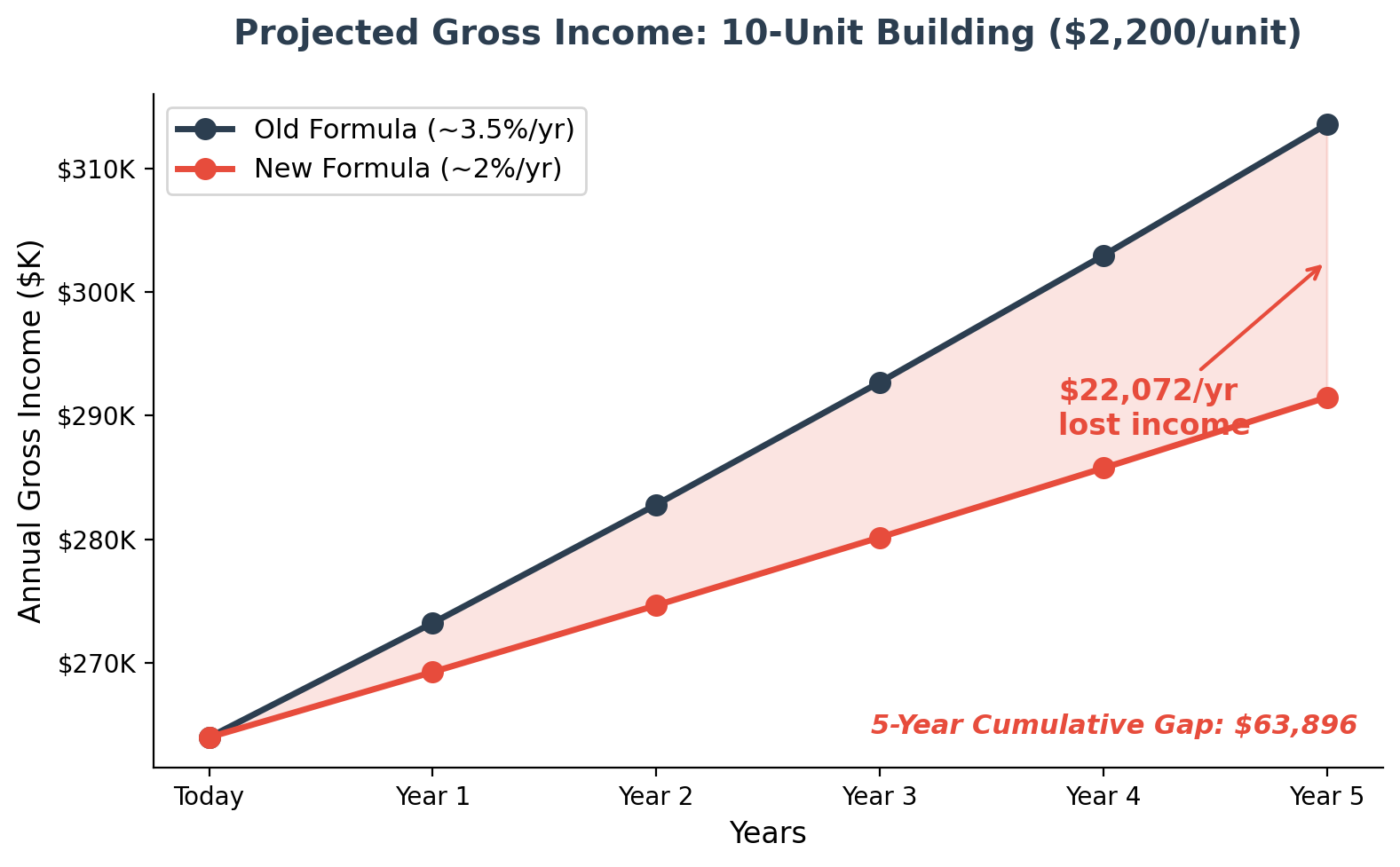
Over five years, you're looking at tens of thousands in cumulative lost income. And that's before you factor in how it affects your property's value. Lower income growth means lower NOI growth, which means slower appreciation.
What About the Master Meter Add-On?
This one hurts. Under the old rules, if your building had master metered gas or electric (meaning the landlord pays utilities, not individual tenants), you could tack on an extra 1% above the annual increase. That's gone.
If you own older buildings on the Westside where master metering is common, this directly hits your bottom line. You're still paying the utility bill. You just can't pass as much of it through to tenants anymore.
What This Means for Property Values
Cap rates on the Westside have already expanded from the low 4% range to the mid 5% range over the past 18 months. That adjustment reflected higher interest rates and tighter lending. Now you're adding another headwind: slower rent growth.
Understanding what your apartment building is worth starts with analyzing how rent control impacts your NOI.
A building that was appreciating at 3% to 4% per year through organic rent increases is now looking at 1% to 2% growth under the new formula. That changes the math on hold versus sell. It changes the math on refinancing. And it changes what a buyer is willing to pay.
This doesn't mean values are crashing. The Westside is still the Westside. Demand is strong, vacancies are low, and the location premium isn't going anywhere. But the margin for error just got thinner for owners who were counting on steady rent growth to improve their returns.
What You Can Do Right Now
- Implement your current increase immediately. If you haven't already posted your 3% increase for 2025-2026, do it now. You have until June 30 before the new rules take over.
- Review your operating expenses. With tighter rent growth, controlling expenses becomes more important. Look at insurance, maintenance contracts, and utility costs. Every dollar you save on the expense side flows directly to NOI.
- Consider capital improvements. The RSO still allows landlords to apply for capital improvement surcharges above and beyond the annual increase. If your building needs work anyway, structuring it as a capital improvement can help offset the lower annual cap.
- Evaluate your hold strategy. For some owners, this change tips the scale. If you were already thinking about selling in the next few years, the combination of expanded cap rates and slower rent growth might make now a better exit window than 2028 or 2029.
- Talk to your CPA about tax planning. The income projections for your building just changed. Your tax advisor can help you understand how this affects depreciation schedules, 1031 exchange timing, and overall portfolio strategy.
The Bigger Picture
This vote didn't happen in a vacuum. LA has been steadily tightening tenant protections for years. AB 1482 capped statewide increases at 5% plus CPI. The Just Cause Ordinance expanded eviction protections to non-RSO units. And now the City Council is squeezing the annual increase formula itself.
None of this is going to reverse. The political momentum in LA runs in one direction on housing policy. As an owner, you have to plan around that reality, not hope it changes.
Santa Monica owners face a separate set of rules under Santa Monica rent control.
The owners who do well in this environment are the ones who stay informed, run tight operations, and make strategic decisions based on current rules rather than nostalgia for how things used to work.
Need Help Evaluating Your Options?
If you own a rent stabilized apartment building on the Westside and want to understand how these changes affect your specific situation, I'm happy to run the numbers with you. Sometimes a 15 minute conversation saves months of uncertainty.
Want to know how this policy change affects your building's value? Request a free valuation.
Don Favia | President, Favia Investment Group
Specializing in Westside LA Multifamily Investments
📞 424-377-6002 | 📧 dfavia@riacre.com