Favia Investment Group | Market Insights
The Complete Guide to Selling Your Santa Monica Apartment Building
By Don Favia | Updated July 2, 2026
https://www.faviainvestmentgroup.com/market-insights/how-to-sell-your-santa-monica-apartment-building
If you are thinking about whether to sell your apartment building in Santa Monica, start with the real question: what would a buyer actually pay for it today?
Not what the building felt like it was worth at the 2021 peak. Not what a neighbor asked for on LoopNet. Not the number that makes the tax bill feel better.
The number a serious multifamily buyer can underwrite.
Santa Monica is a great market, but it is not a simple one. Rent control affects the income story. Measure GS can change your net proceeds by hundreds of thousands of dollars. Buyers are active again, but they are not careless. They are looking at current income, rent control records, expenses, unit condition, and the transfer tax math before they write.
That is why preparation matters. A clean, well priced Santa Monica building can still get strong attention. A loose story with messy documents and an inflated price usually sits.
I have spent 20 years in West LA multifamily investment sales, with more than 100 transactions, $370M+ in career volume, and 850+ units traded across Santa Monica, Brentwood, West LA, Mar Vista, Westwood, Palms, and nearby Westside markets.[1] This is the practical version of what I would want a Santa Monica owner to know before listing.
Selling a Santa Monica Apartment Building Starts With the Rent Roll
Santa Monica buyers care about location. Of course they do. But the first real underwriting pass starts with the rent roll.
Most residential buildings built before April 10, 1979 are covered by Santa Monica rent control.[2] That means buyers are not guessing at upside the way they might in a free market building. They are looking at Maximum Allowable Rent, actual rent, tenant history, annual adjustments, pending Rent Control Board issues, and how realistic the turnover story is.
For 2025, Santa Monica's general adjustment was 2.3%.[3] That matters. If expenses are rising faster than controlled rents, current income becomes more important. Buyers may still pay for upside, but they discount it more than they did when debt was cheap and the regulatory environment felt easier.
Here is the simple way to think about it:
- Strong current cash flow helps pricing.
- Below market rents still have value, but buyers will not pay full price for imaginary turnover.
- Clean rent control records reduce friction.
- Surprises during due diligence cost money.
If you want the deeper version, my Santa Monica rent control guide walks through the rules in more detail.
Know the Three Numbers Buyers Will Test
Before you sell your Santa Monica apartment building, know three numbers cold: NOI, cap rate, and GRM.
NOI. Net Operating Income is your rental income minus operating expenses. Not debt service. Not depreciation. Not capital improvements. Buyers will normalize expenses and decide what income they believe.
Cap rate. Based on current Favia pricing intelligence for Westside multifamily, stabilized buildings are around 5.5% to 5.75%. Value add buildings are around 4.75% to 5.25%.[4] A lower cap rate means a higher price for the same NOI.
GRM. Based on the same pricing intelligence, Westside GRMs are currently around 11.0 to 14.5, depending on the building, rents, location, and condition.[4] GRM is not a full valuation method, but buyers use it as a quick reality check.
A basic example:
Say a 10 unit building produces $320,000 in annual gross rent and $210,000 in NOI. At a 5.5% cap rate, that points to about $3.82 million. At a 5.75% cap rate, it points to about $3.65 million. The same income, different buyer yield, different value.
That is why pricing is not about one metric. Price per unit, price per foot, cap rate, and GRM all need to reconcile with the comps. If one of them is wildly out of line, buyers will notice.
A Broker Opinion of Value should show that math clearly. If it does not, it is not doing its job.
Measure GS Can Change the Whole Sale
This is the part many Santa Monica owners underestimate.
Measure ULA does not apply to Santa Monica. Santa Monica is its own city and has its own transfer tax: Measure GS.[5]
The tiers are straightforward, but the impact is not:
- Under $5 million: 0.3% city tax, 0.41% total with county
- $5 million to $8 million: 0.6% city tax, 0.71% total with county
- $8 million and above: 5.6% city tax, 5.71% total with county[6]
The important part: the tax applies to the entire sale price, not just the amount above the threshold.[6]
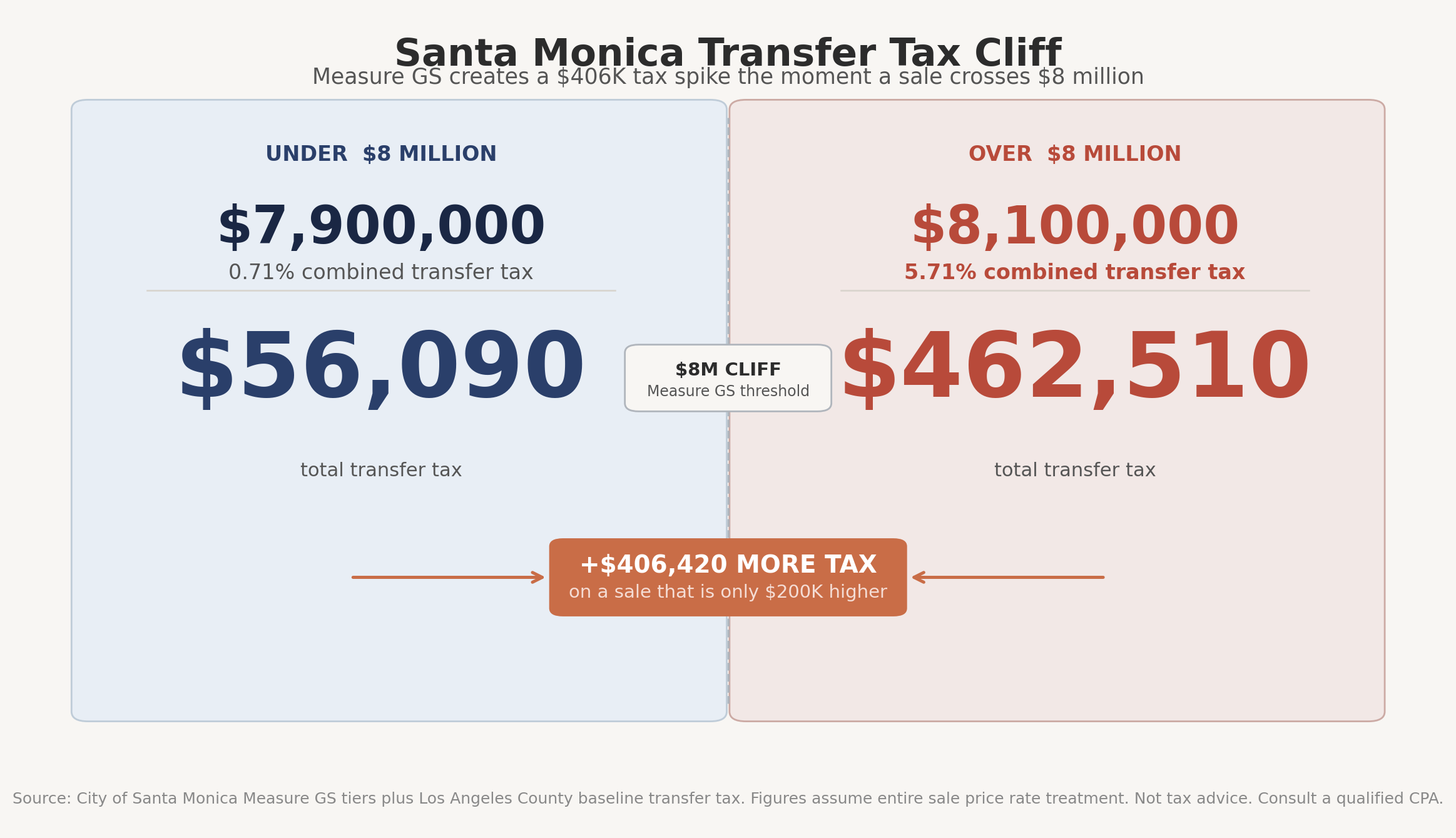
A sale at $7.9 million produces about $56,090 in total transfer tax. A sale at $8.1 million produces about $462,510. That is roughly $406,420 more tax on a $200,000 higher sale price.
That does not mean every building near $8 million should be priced below the threshold. It means the math has to be modeled before you list. In some cases the higher price still wins. In others, the seller nets less by crossing the line.
Any structuring conversation needs to involve your CPA and attorney. Personal property allocations, seller credits, installment sale treatment, and other items need to be real, documented, and specific to your situation. This is not a place for casual advice.
Measure GS had generated about $79.3 million as of February 2026.[7] There is also a November 2026 ballot effort that could affect local transfer taxes after a two year period if it passes.[8] If your building is near the threshold, it is worth watching. But if you are selling before the law changes, assume the tax applies.
The Market Is Active, Not Easy
Buyers who were quiet in 2023 and 2024 are looking again. For more local context, see the Santa Monica multifamily market update.
For owners near the city core, there is another layer to watch: downtown Santa Monica's attempt to rebuild activity around the Promenade. That recovery is still uneven, but it can affect buyer psychology. I covered the buyer angle in Santa Monica's downtown reset.
But this is not a frenzy. Buyers see opportunity, but they are disciplined. They are not paying yesterday's price with today's debt.
That creates a workable market for owners who are realistic.
A good building with clean documents, supportable income, and a price that matches the comps can trade. A building priced off nostalgia usually struggles. The market will not punish you for being thoughtful. It will punish you for pretending rates, expenses, and rent control do not matter.
For a broader timing discussion, see When Is the Right Time to Sell Your Apartment Building?.
Get the Documents Clean Before You Go Out
Due diligence is where Santa Monica deals get tested. If the buyer finds a problem you should have known about, the negotiation usually comes back to price.
Before listing, organize these:
- Current rent roll with unit numbers, lease dates, actual rent, and MAR
- Rent Control Board registration records
- Any pending petitions, complaints, or board orders
- Operating statements and utility bills
- Property tax and insurance records
- Lease files and security deposit records
- Recent roof, termite, seismic, or major repair documentation
- Permits for meaningful renovations
- Any Ellis Act history, if applicable
This does not need to be glamorous. It needs to be complete.
A buyer who trusts the file spends less time looking for reasons to retrade. A buyer who thinks the story is sloppy will assume there are more issues hiding behind the first one.
Pick a Broker Who Actually Knows Santa Monica Multifamily
Santa Monica is not just another LA submarket. The rent control system, Measure GS, buyer pool, and comp set are specific.
You want someone who can explain the MAR system without guessing. Someone who understands how buyers discount upside in controlled units. Someone who can model the Measure GS cliff before the asking price goes public.
Ask three questions:
- 1. How many Santa Monica multifamily deals have you handled?
- 2. How would you price a building near the $8 million Measure GS threshold?
- 3. What documents do you need before launching the listing?
The answers should be specific. If they sound generic, that tells you something.
You can see more about my Santa Monica work here: Santa Monica multifamily broker.
Common Questions From Santa Monica Owners
Will rent control scare buyers away?
No. Santa Monica buyers expect rent control. What scares them is bad information: missing MAR records, undisclosed tenant issues, or a rent roll that does not match the board records.
Should I wait for a low rent tenant to move before selling?
Maybe, but do not let hope become the strategy. If there is a real sign a tenant may leave, it can be worth understanding that before listing. If there is no certainty, make the sale decision based on your broader goals and price around what exists today.
Can I use the Ellis Act before selling?
Technically, the Ellis Act exists. Practically, it is rare as a pre sale strategy. It can involve long timelines, relocation payments, and legal risk. Talk with a Santa Monica rent control attorney before considering it.
What if my building is worth less than I expected?
That is not unusual right now. Rates, expenses, rent control, and transfer taxes have changed the math. The first step is getting a grounded valuation. Then decide whether to sell, hold, refinance, exchange, or wait.
Bottom Line
Selling a Santa Monica apartment building is not just a listing exercise. It is a pricing, tax, rent control, and documentation exercise.
The owners who do best usually do the simple things early. They get a real valuation. They clean up the rent roll. They understand Measure GS before setting a price. They work with a broker who knows the buyer pool and can defend the number.
If you are thinking about selling now, next year, or five years from now, start with the valuation. You do not need to list to know where you stand.
I will give you a direct read on the numbers, the comps, and the likely buyer response. No pressure. Just the market as it is.
Get a free Broker Opinion of Value: faviainvestmentgroup.com/valuation
Call: 424-377-6002
Email: dfavia@realtyinvadvisors.com
Don Favia is President of Favia Investment Group, operating under Realty Investment Advisors (DRE #02063191). Cal DRE #01841258.
Sources
[1] Favia Investment Group track record, verified at faviainvestmentgroup.com/about. [2] Santa Monica Rent Control Board, Rent Control Law overview. [3] Santa Monica Rent Control Board, 2025 Annual General Adjustment. [4] Favia pricing intelligence, Westside multifamily, updated March 2026. [5] Hanson Bridgett summary of Measure ULA and Santa Monica Measure GS applicability. [6] City of Santa Monica, Measure GS transfer tax tiers. [7] City of Santa Monica, Measure GS revenue reporting, February 2026. [8] Howard Jarvis Taxpayers Association ballot initiative filing, California Secretary of State, 2025.
This is for general informational purposes only. Consult with your CPA, tax advisor, and/or attorney for guidance specific to your situation.