Favia Investment Group | Market Insights
Santa Monica Rents Drop 8.1%: Why Multifamily Buyers Are Paying Attention
By Don Favia | Updated July 2, 2026
https://www.faviainvestmentgroup.com/market-insights/santa-monica-rent-decline-2026
This is for general informational purposes only. Consult with your CPA, tax advisor, and/or attorney for guidance specific to your situation.
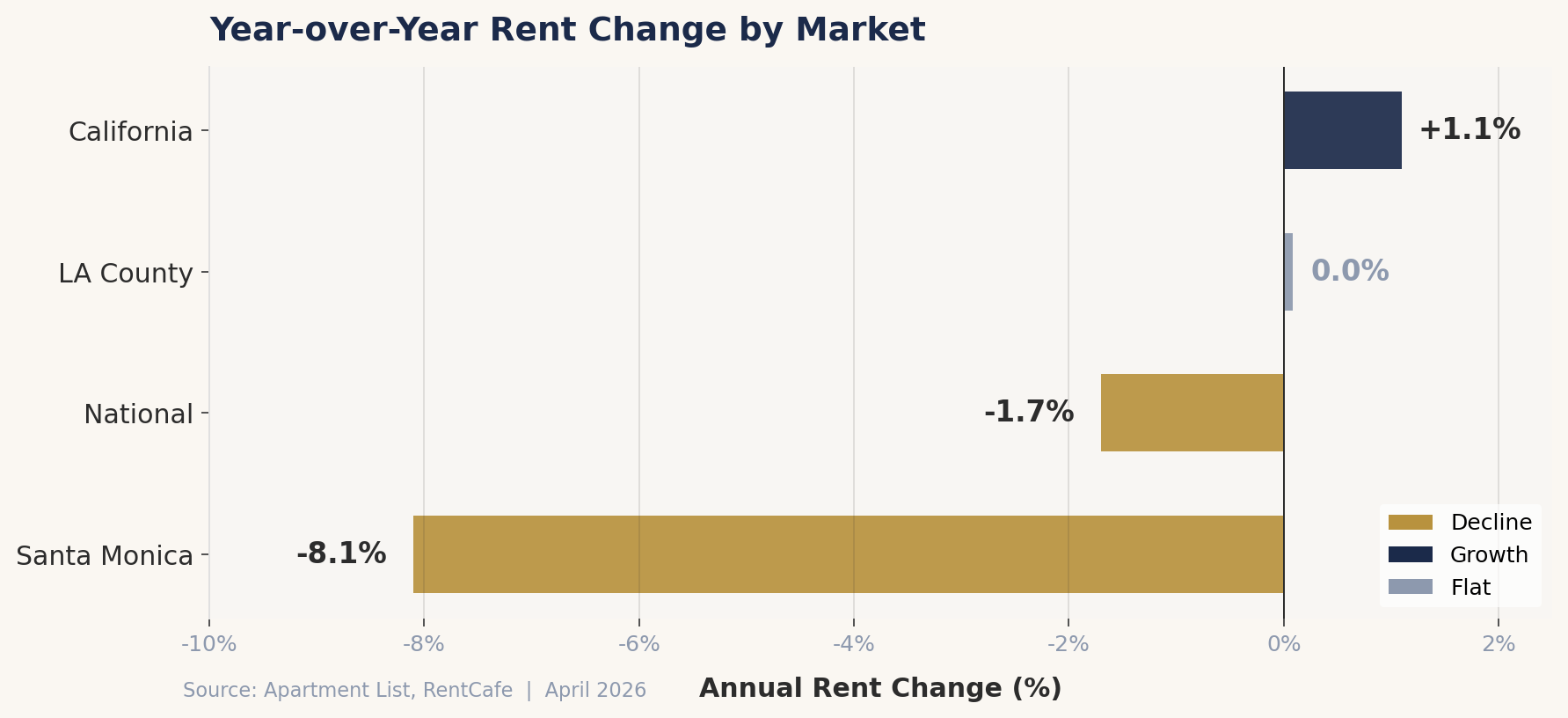
Santa Monica rents just posted the sharpest annual decline of any city in the Los Angeles metro. According to Apartment List's April 2026 report, the city's median rent fell 8.1% year over year. Zumper's data shows an even steeper 12% drop.
The median rent in Santa Monica now sits at $2,328 per month, down nearly $200 from a year ago when it stood at $2,527.
For multifamily investors watching the Westside, the real story is below that headline. The data points toward something buyers in this market have been waiting for.
The Numbers in Context
The rent decline shows up across every major data source:
- Apartment List: 8.1% annual decline (citywide median)
- Zumper: 12% year over year (listing-based data)
- RentCafe: 0.4% decline (larger buildings only)
The variation matters. RentCafe tracks mostly institutional-grade buildings, which hold rent better. Apartment List and Zumper capture the broader market, including smaller properties where the pricing pressure is more noticeable.
By unit type, the pattern holds. One-bedroom units fell from $2,392 to $2,203. Two-bedrooms dropped from $2,867 to $2,641.
For comparison, LA County as a whole is essentially flat, up just 0.03% according to RentCafe. California statewide rents rose 1.1%. Santa Monica is the outlier moving downward.
The rent story is one half of the picture. The other half is neighborhood confidence, especially around the Promenade and downtown core. For that angle, see our breakdown of Santa Monica's downtown reset for multifamily investors.
Rent Declines Across the Reported Periods
This didn't start overnight. The figures below cover 2023, 2024, and the annual change reported through March 2026.
- 2023: Down 5.9%
- 2024: Down 1.1%
- 2026 (through March): Down 8.1%
That follows a massive run-up in 2021 and 2022, when pandemic demand pushed rents up more than 20% cumulatively.
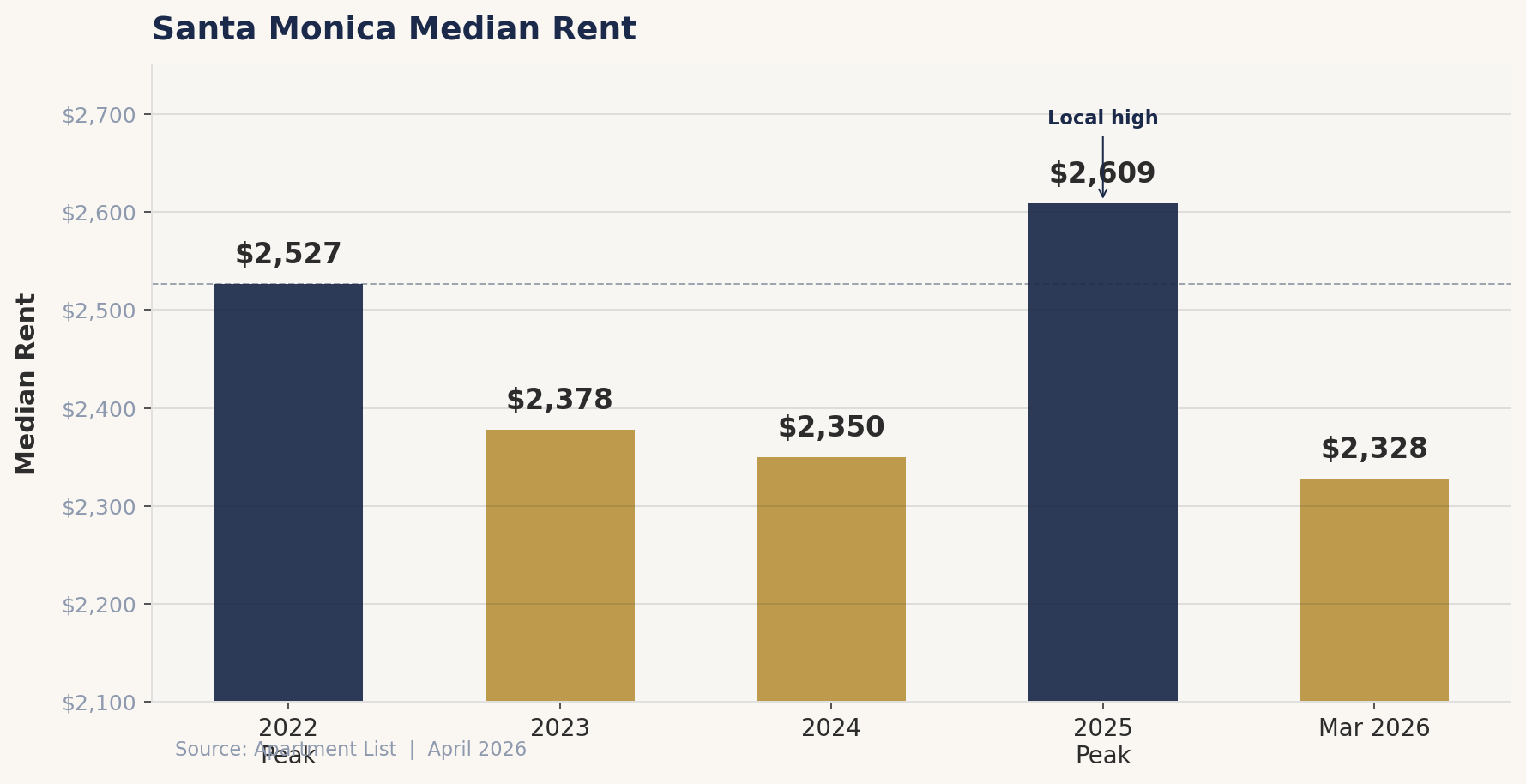
There was a brief interruption. The January 2025 Palisades Fire displaced tens of thousands of residents from Pacific Palisades, and Santa Monica saw a short demand spike. By March 2025, Apartment List recorded 2.9% year over year growth. That reversed by summer, and the downward trend resumed.
The fire bounce was real but temporary. It masked an already weakening rental market.
Why Buyers See Opportunity Here
For investors who have been waiting for Westside pricing to reset, the numbers are starting to align.
Acquisition prices are down from peak. Buildings that traded at top dollar in 2021 and 2022 are available at materially lower acquisition prices. The combination of rent declines and cap rate expansion means today's pricing reflects a market correction rather than a market peak.
Cap rates have expanded. Westside cap rates for stabilized multifamily assets are now running 5.5% to 5.75%. Value-add deals trade in the 4.75% to 5.25% range. That's 40 basis points wider than recent history. More yield on day one, with less risk of buying at the top.
The construction pipeline is shrinking. Kidder Mathews reported a 21% decline in new multifamily starts across LA County. Fewer units coming online means less competitive pressure on existing buildings. The supply wave that helped push rents down is starting to recede.
Transaction volume is surging. Nearly 30,000 units traded in LA County in 2025, up 52% from 2023. Buyers are active. Liquidity is real. The market isn't frozen. Sellers are transacting, and buyers who accepted Measure ULA structuring are doing deals at volumes not seen in years.
Rent stabilization may be closer than it looks. The construction pipeline pulling back, combined with still-strong demand for coastal living, suggests the steep part of the correction is behind us. Buyers who enter now are pricing in the bottom rather than the middle.
What This Means for Sellers
The picture looks different depending on when you bought.
For owners who purchased in 2021 or 2022, the math is straightforward. You paid near the top, and the asset has not appreciated as expected. Transaction volume is healthy, buyers are motivated, and waiting for rents to recover means competing with every other owner who has the same timeline. Explore the full Santa Monica multifamily market trends for more detail.
For owners who have held for a decade or more, the position is stronger. Even after the correction, Santa Monica values remain well above pre-pandemic levels. Selling now means transacting while volume is strong and buyers are engaged. The question is whether the current bid is worth taking, or whether rent stabilization and cap rate compression will deliver a better exit in 18 to 24 months.
The Factors Behind the Decline
Three structural pressures are weighing on Santa Monica rents:
New supply. A wave of multifamily development has added hundreds of new units. Studios and one-bedrooms, the types most exposed to competition from new inventory, are showing the largest percentage drops. New buildings with concessions and updated finishes pull renters away from older stock. This pressure is already easing as construction starts decline.
Rent control. Santa Monica's ordinance limits annual increases to roughly 3% with a dollar cap around $60 per month. Revenue growth is structurally capped regardless of market conditions. Read the full rent control breakdown.
Population outflows. High costs and remote work flexibility continue to pull residents to more affordable neighboring cities. This is a long-term trend with no quick reversal in sight.
The Bottom Line
Santa Monica rents are falling, and the data is clear across every major source. For multifamily buyers, that same data describes an entry point that hasn't existed since before the 2021 run-up. Expanded cap rates, shrinking construction pipeline, and surging transaction volume are the kind of conditions that active buyers look for.
For sellers, the market offers liquidity and motivated buyers. For buyers, it offers pricing that reflects the correction.
The opportunity isn't in the headline. It's in what happens next.
Want to see what your building is worth in today's market? Get a free valuation.
Have questions about multifamily investment on the Westside? Reach Don Favia at dfavia@realtyinvadvisors.com or 424-377-6002.