Favia Investment Group | Market Insights
Selling a Rent-Controlled Apartment Building in Santa Monica: What Owners Need to Know in 2026
By Don Favia | Updated March 16, 2026
https://www.faviainvestmentgroup.com/market-insights/selling-rent-controlled-apartment-santa-monica
If you own a rent-controlled apartment building in Santa Monica, you have probably asked yourself: is this still the right time to sell, or do I wait it out?
That question comes up in almost every conversation I have with long-term owners right now. And the honest answer is that the calculation has shifted. The legislative environment has changed. Buyer priorities have changed. The math that made sense in 2019 looks different today.
I have been selling Westside multifamily for 20 years. Over $370M in career transaction volume, 850+ units, 100+ deals. Here is what owners need to know about selling rent-controlled property in Santa Monica in 2026.
The Buyer Mindset Has Flipped
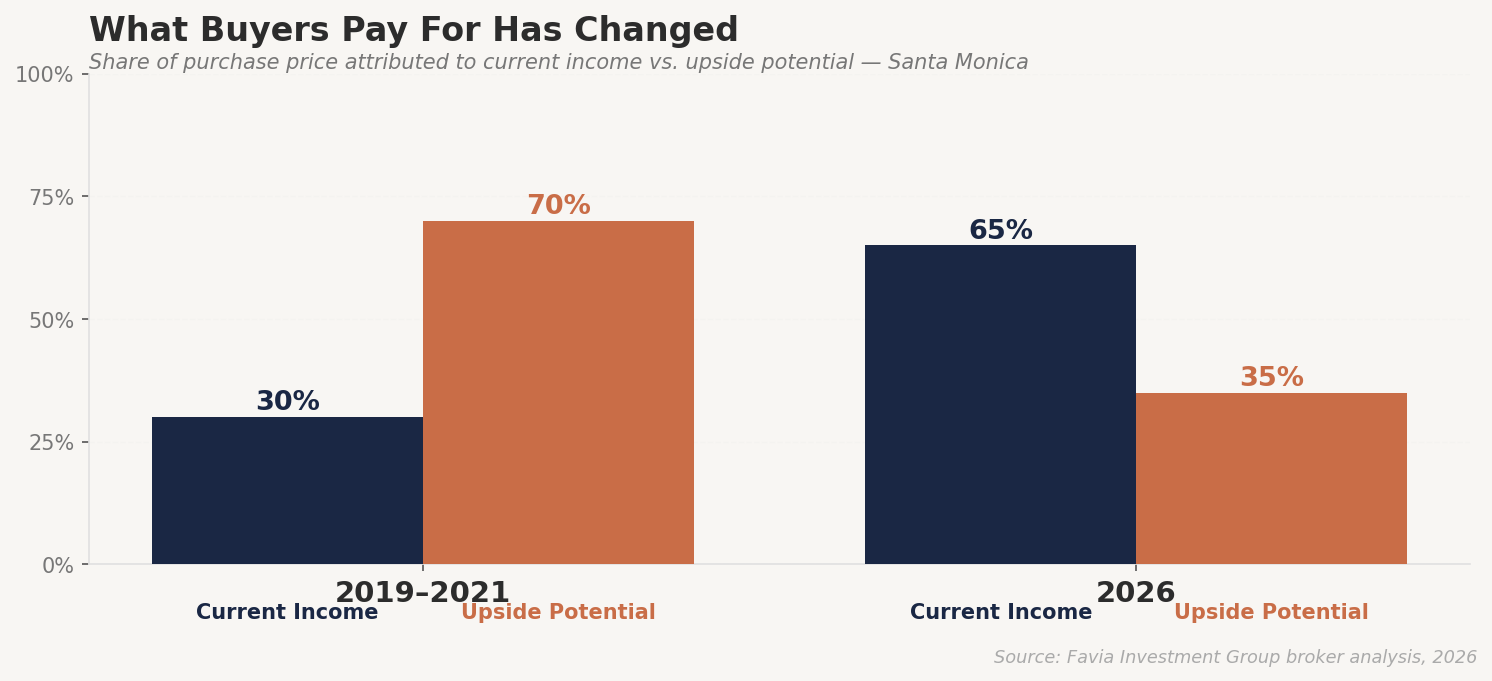
Five years ago, buyers paid a premium for upside. They would look at a building with below-market rents and pay full freight based on the assumption they could buy out tenants, renovate, and capture market rents.
That calculus has changed.
Today's buyers pay more for current income than upside. The anti-landlord legislative environment in Santa Monica and Los Angeles has compressed what buyers are willing to pay for future vacancy decontrol. Buyers still value upside. But they discount it heavily.
Here is why:
Santa Monica rent-controlled tenants are increasingly sophisticated. The city publishes registered rents publicly and emails tenants directly to inform them of their rights. Many long-term tenants stay current on tenant-friendly legislation. When you approach them about a buyout, they already know the playbook.
The regulations also require extensive documentation before any buyout negotiation can begin. Even after reaching an agreement, tenants can back out. This makes the "done deal" unreliable in a way it was not five years ago.
The result: a building with strong current cash flow is more valuable today than an identical building with below-market rents and "upside potential." That is a meaningful shift from any point in recent memory.
Why Your Building Is Not Worthless
The number one misconception I hear from sellers: "My building is worth nothing because my rents are ten years below market."
This is not true.
Santa Monica land value creates a price floor regardless of rent roll. You are sitting on one of the most prestigious locations in Los Angeles County. Location premium and land value protect your asset even in today's income-driven pricing environment.
Sophisticated buyers also factor in the Ellis Act as a ceiling on how far they can discount a building. Ellis Act rarely comes up in negotiations — it is not a deal point, it is a post-purchase option buyers retain. But its existence keeps buyers from pricing buildings at zero even with very low rents.
When I sit down with owners who think their building is worthless, I start with comps. Not theory. Comps tell the story better than any valuation model. And the comps show that Santa Monica rent-controlled buildings trade every month. There is always a floor.
The key is comparing apples to apples. Rent-controlled to rent-controlled. Renovated vacants to renovated vacants. The wrong comp destroys seller confidence immediately. The right comp shows what the market is actually paying.
Start here: what is my apartment building worth?
Timing the Sale Around Your Rent Roll
Should you wait for that low-rent tenant to leave before listing?
If there is a clear signal a tenant is planning to depart, flush it out first. A vacant unit at market rent improves the offering memorandum and gives buyers confidence in the income stream they are underwriting.
But do not wait forever. I have seen owners hold off selling for years, hoping for a turnover that never comes. The decision to sell should be independent of tenant timing. It should be driven by lifestyle choice, equity repositioning, or the 1031 opportunity in front of you right now.
We optimize around what we know, not what we hope for.
Who Is Buying Santa Monica Rent-Controlled Buildings in 2026
The buyer pool remains active. Two groups dominate.
1031 exchange buyers still target Santa Monica as a destination market. The relative stability of Westside multifamily attracts capital from owners selling elsewhere. Exchange buyers have deadlines, they have equity, and they will pay a premium that a strict yield analysis would not support. That keeps a floor under premium submarkets.
Private family owners who already own multiple Santa Monica buildings are often the best buyers. They understand the regulatory environment. They are not scared off by rent control. They already know the tenant landscape. These buyers close.
A few things worth knowing about where buyers stand right now. The mansion tax on larger Santa Monica properties has already moved values significantly from a few years ago. Buyers are pricing this in on anything above the threshold. Additionally, interest rates have been stickier than many expected. Waiting for the perfect rate environment is not a bankable strategy. The buyers are not waiting either.
The Inspection Process Is Simpler Than Owners Fear
Many owners worry that posting a 24-hour inspection notice will cause tenants to panic and move out. This almost never happens.
The process is straightforward: post the notice on the door, photograph it, document it. After 24 hours, the notice is valid. Tenants who are treated with respect are accommodating in the vast majority of cases. This is a known part of every transaction. It is not a reason to avoid selling.
The more important point: Santa Monica tenants are informed. The city emails them their registered rent. They follow tenant advocacy groups. Come to any interaction from a position of knowledge, not improvisation. Respect goes both ways, and in this market it almost always gets returned.
How Unit Mix Affects Pricing
Not all buildings price the same, even at the same unit count and location.
Buildings with 2-bedroom and 3-bedroom units command a higher price per unit than studio-heavy buildings. The tradeoff is price per square foot, which runs lower on larger units. Pricing reconciles multiple metrics simultaneously: price per unit, price per foot, cap rate, and GRM. No single number tells the full story.
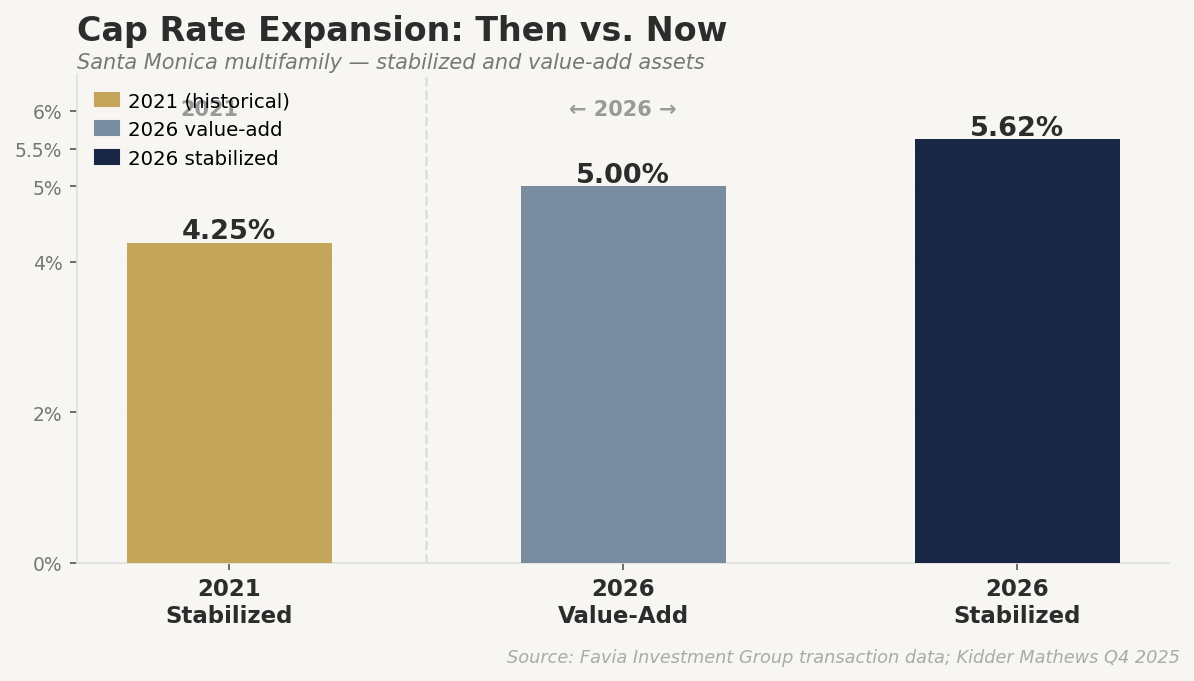
For current cap rate and GRM ranges across the Westside, see Westside multifamily cap rates in 2026.
One Thing Every Long-Term Owner Needs to Hear
If you have owned your building for 20 years, here is the most important thing I can tell you:
Get a valuation. Even if you are not selling today. Even if you are thinking about it in five years. Know where you stand. You cannot make a good decision with bad information.
Nobody has a crystal ball. You can only base decisions on today's market, not what it was three years ago. And the opportunity cost of staying in a 20-year-old building with a worn depreciation basis deserves an honest look.
The 1031 exchange environment right now may be the best buying opportunity in my career. Less competition for up-legs. Up-leg inventory with better long-term potential than many sellers expect. You are selling and buying in the same market, so the "lower price" on the sell side is often offset by the "better deal" on the buy side. The new depreciation basis alone is a tax benefit that long-term holders consistently undervalue. Consult your CPA on the specifics.
This is a big decision. But it is exactly what I do.
AB 1482 and the Santa Monica RSO
AB 1482, California's statewide rent cap, runs alongside Santa Monica's local Rent Control Charter Amendment. Santa Monica's RSO is generally more restrictive and applies to most buildings constructed before 1979. Newer construction may fall under AB 1482, which allows more flexibility but still limits annual rent increases.
Buyers will underwrite based on which regime applies to each unit. Understanding this matters before you go to market. For more on how recent changes to allowable rent increases affect your building's income, see our post on LA City slashing RSO rent increases.
Where to Start
Selling a rent-controlled building in Santa Monica requires specialized knowledge. The buyer pool is specific. The regulatory environment is unique. The pricing methodology has shifted.
Start with a valuation. Even if you are not ready to sell. Request a property valuation here or call me directly at 424-377-6002.
Disclaimer: This is for general informational purposes only and should not be considered legal, tax, or financial advice. Market data reflects conditions as of March 2026 and is subject to change. Consult with your CPA, tax advisor, and/or attorney for guidance specific to your situation.
Don Favia is President of Favia Investment Group, operating under Realty Investment Advisors (DRE #02063191). Cal DRE #01841258.