Favia Investment Group | Market Insights
Measure ULA Reform: What Los Angeles Apartment Building Owners Should Watch Before November 2026
By Don Favia | Updated May 27, 2026
https://www.faviainvestmentgroup.com/market-insights/measure-ula-reform-los-angeles-apartment-owners-2026
This is for general informational purposes only. Consult with your CPA, tax advisor, and/or attorney for guidance specific to your situation. Measure ULA rules, ballot language, and local reform proposals can change.
Measure ULA reform is back on the table, and Los Angeles apartment owners should pay attention.
For the last three years, most sellers have treated ULA as a painful closing cost. Expensive, yes. But at least known. That is no longer a safe assumption.
Before November 2026, owners may have to underwrite three different outcomes:
- ULA stays the way it is.
- A statewide measure limits local real estate transfer taxes.
- Los Angeles voters get a local ULA reform measure.
No one knows which outcome wins. The point is simpler: if your building could sell above the ULA threshold, the tax can change your net proceeds, your buyer pool, and your timing.
Where Measure ULA Stands Today
ULA applies to qualifying real estate transfers in the City of Los Angeles. It does not apply in Santa Monica, Culver City, Beverly Hills, or countywide.
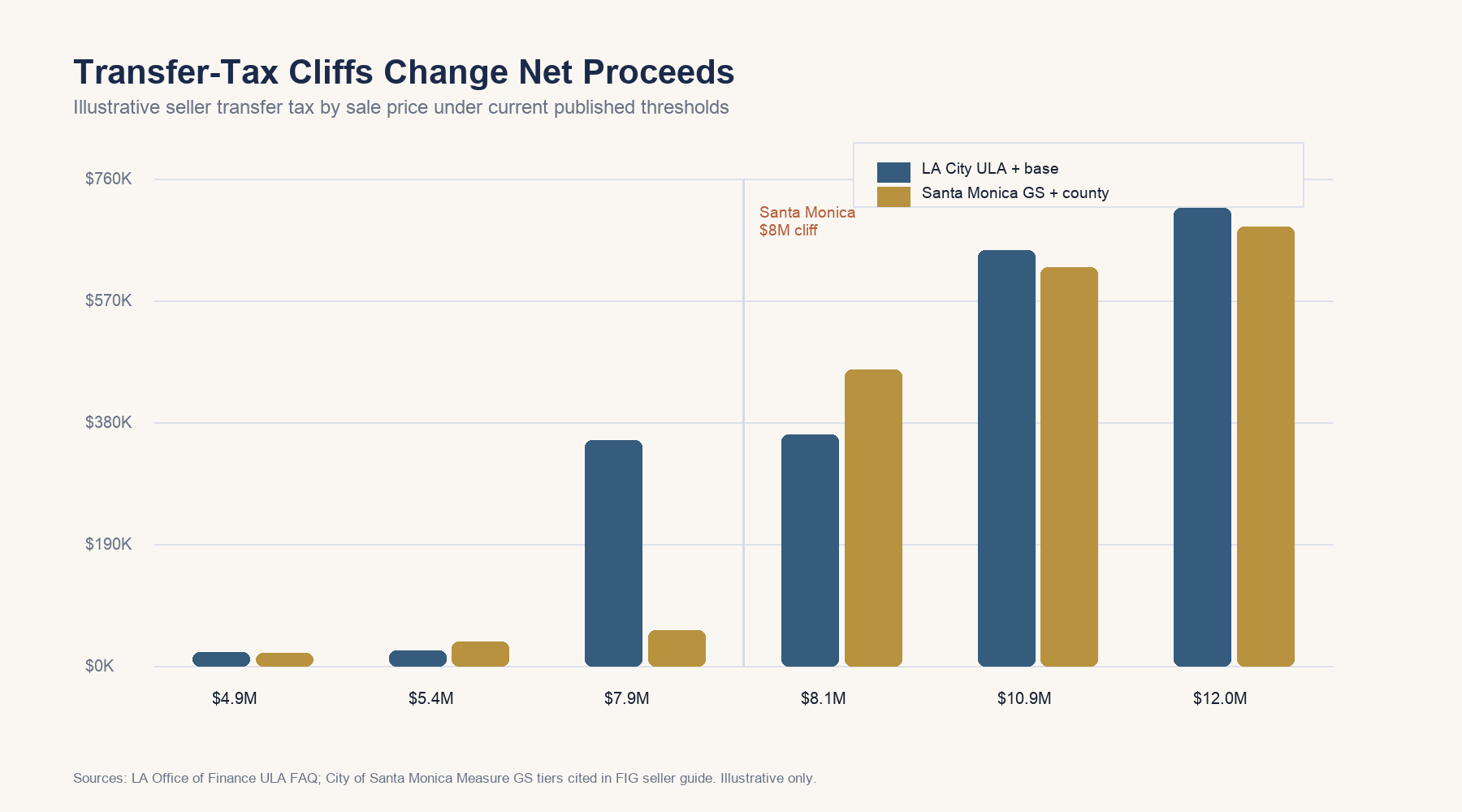
The Los Angeles Office of Finance currently lists the first ULA tier at 4% from $5.3 million through just under $10.6 million. The second tier is 5.5% starting at $10.6 million. The City's base transfer tax still sits on top of that at $2.25 per $500, or roughly 0.45%.
The thresholds move. For transactions closing after June 30, 2026, the Office of Finance says the ULA thresholds will increase to $5.4 million and $10.9 million.
That is a real number for owners close to the line. A small change in price can create a much larger change in net proceeds.
If you are trying to understand that math on your building, start with a real valuation instead of a rule of thumb. FIG offers a complimentary broker opinion of value.
Why November 2026 Matters
The California Secretary of State lists initiative 1983, titled "Limits Ability of Voters to Raise Revenues for Local Government Services," as eligible for the November 2026 ballot.
As of the Secretary of State's May 2026 status page, the measure is eligible. Eligible measures become qualified on the 131st day before the next statewide general election unless they are withdrawn before then.
The official summary says the measure would raise the approval threshold for voter-proposed local special taxes from a simple majority to two-thirds. It would also prohibit charter-city voters from approving real estate transfer taxes above the existing 0.11% transfer tax authorized by Revenue and Taxation Code section 11911. Existing noncompliant property-related taxes would be overturned two years after enactment.
That is why apartment owners should not treat ULA as settled law forever. If the measure passes and applies as summarized, ULA may change. If it fails, ULA could keep running unless Los Angeles voters approve a separate local fix.
The Local ULA Reform Push
There is also a local reform conversation.
Affordable LA's April 2026 "Mend It, Don't End It" briefing proposes keeping ULA's housing purpose while changing the way the tax applies. It is not current law. It is a reform proposal. But it tells owners where the debate is moving.
According to the Affordable LA April 2026 briefing, the proposal includes a 15-year exemption for newly built multifamily and commercial properties, plus a ULA cap of 1% to 2%, per the report, on non-single-family properties after year 15. It also includes disaster relief, financing flexibility, stronger reporting, and bonding authority.
For existing apartment owners, the rate cap is the piece to watch. For developers, the 15-year exemption is the bigger issue.
This is where bad timing decisions happen. A buyer may discount an offer because reform looks possible. A seller may wait because relief looks possible. Either side can be wrong.
What the Current Data Shows
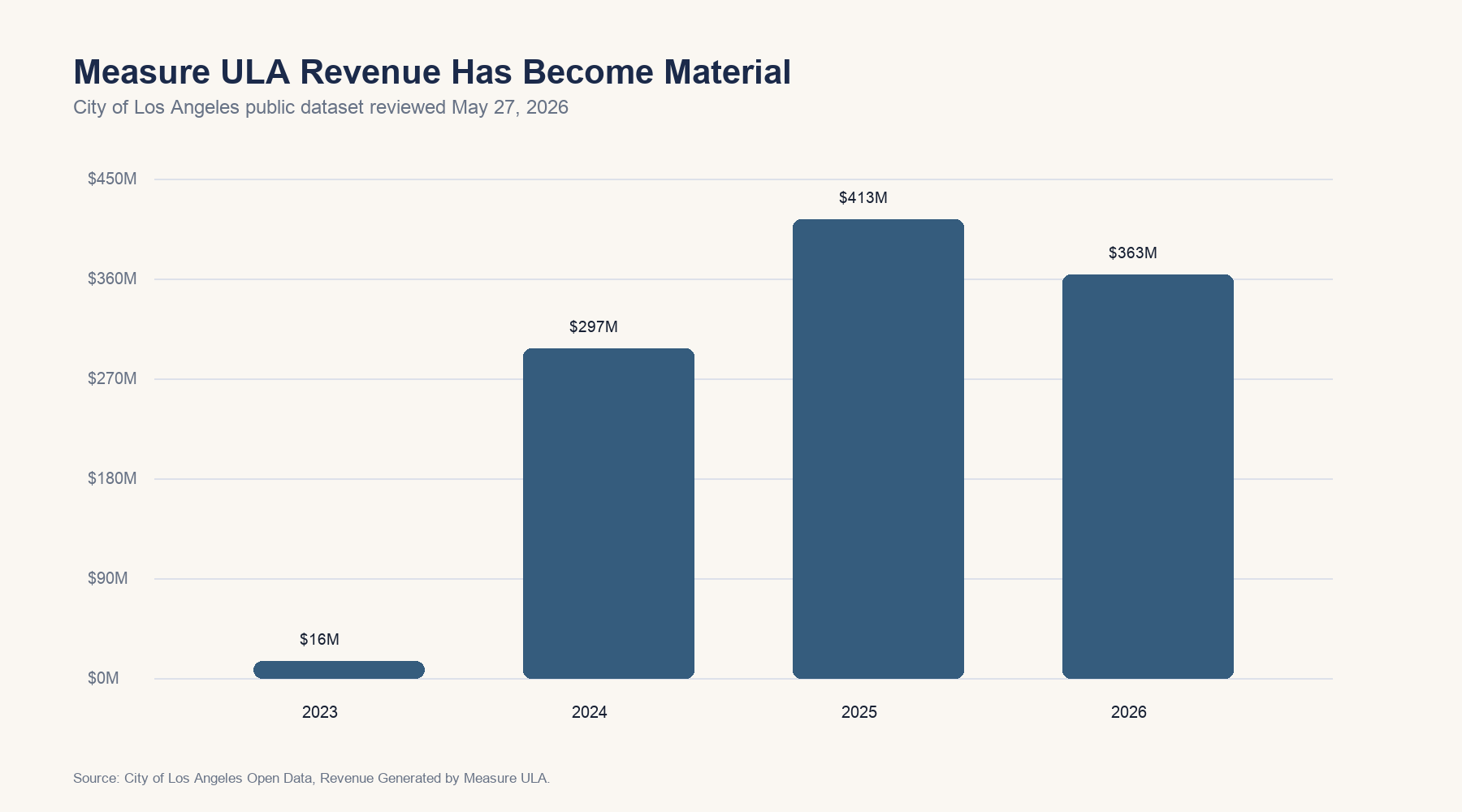
The City of Los Angeles open data portal shows 1,497 ULA transactions and about $1.09 billion in ULA revenue in the public dataset reviewed May 27, 2026.
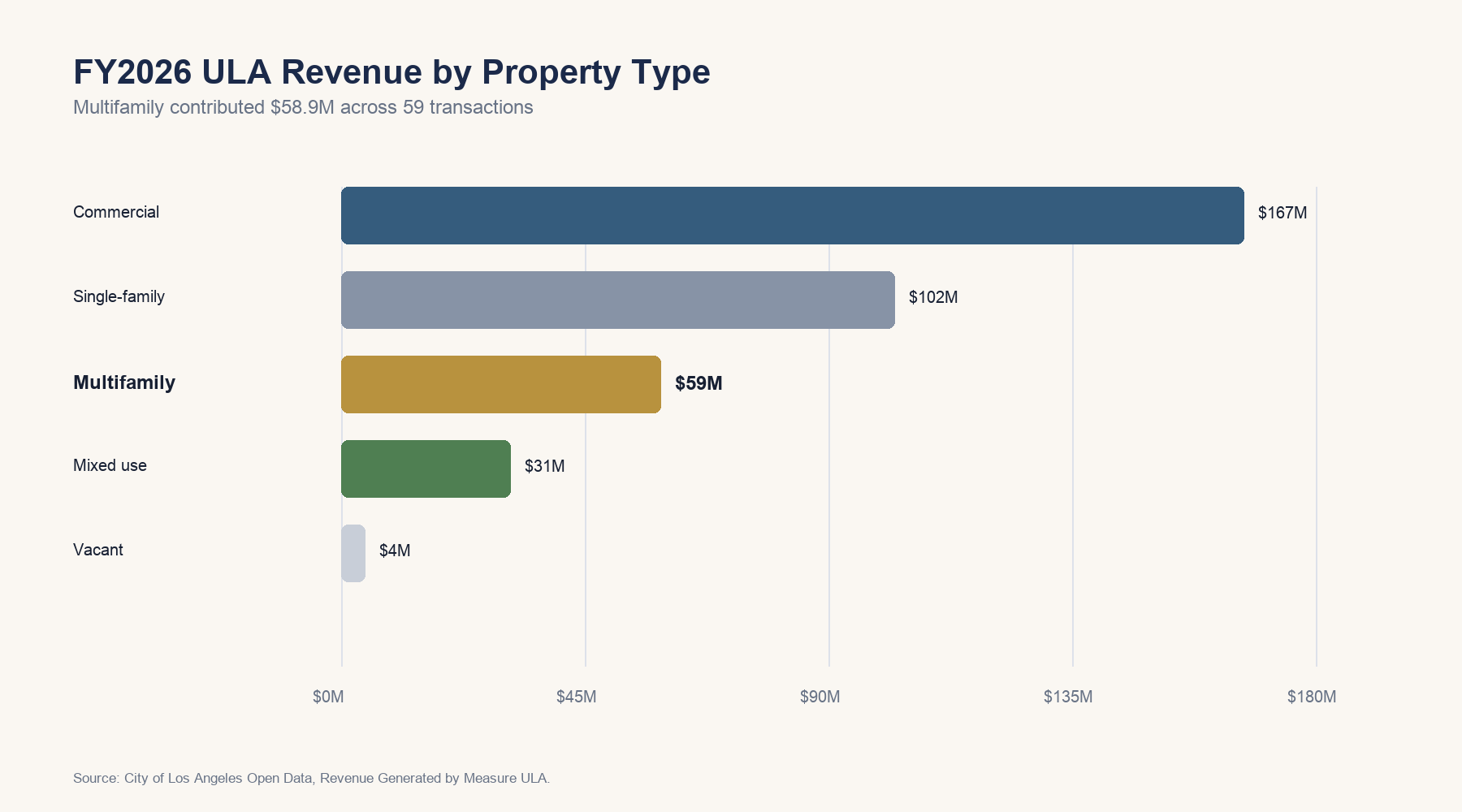
For fiscal year 2026, the dataset shows 412 transactions and about $363.4 million in ULA revenue. Multifamily residential properties accounted for 59 of those FY2026 transactions and about $58.9 million in ULA revenue.
The reform coalition's April 2026 report makes the other argument. It cites a 67% reduction in $5 million-plus transactions in the City of Los Angeles after ULA, based on a RAND Housing Center analysis. It also says $589 million remained unspent across ULA programs. According to the same report, 9.3% of the FY2025-26 expenditure plan had been spent six months into the year.
That briefing is advocacy material, so it should be read that way. But the market point is still important. ULA is no longer being debated only as a housing revenue tool. It is also being debated as a tax that affects sales volume, development, and seller behavior.
How Apartment Owners Should Look At It
If you own an LA City apartment building that could trade above the ULA threshold, I would not make this a political bet. I would make it a math exercise.
Case 1: ULA Stays As-Is
This is the base case.
Sellers keep treating ULA as a direct hit to net proceeds. Buyers keep pricing it into their offers.
That matters because the current Westside market is not loose enough to hide bad assumptions. According to FIG pricing intelligence, stabilized Westside multifamily cap rates are around 5.5% to 5.75%. Value-add cap rates from FIG pricing data are around 4.75% to 5.25%. GRMs from the same pricing data are around 11.0 to 14.5.
That does not mean every building trades in that range. It means the rent roll, unit mix, deferred maintenance, jurisdiction, and buyer profile do the work.
For more context on where buyers are underwriting today, read our Los Angeles multifamily cap rates 2026 update.
Case 2: The Statewide Measure Passes
If the statewide measure passes and applies as summarized, the ULA burden could change materially.
But owners should not count on overnight relief. The Secretary of State summary references a two-year timeline for overturning noncompliant property-related taxes after enactment. There may also be litigation, implementation fights, and local responses.
For sellers, that creates a timing problem. Waiting might preserve upside if the tax is reduced or removed. Waiting might also expose you to market risk, rent-control changes, capital expenditures, or a thinner buyer pool.
The answer depends on the building.
A clean Westside property with durable income may have flexibility. A building with near-term debt maturity may not.
Our LA rent control guide explains why the rent roll matters more than surface-level price-per-unit comps.
Case 3: Los Angeles Reforms ULA Locally
The local reform path is harder to handicap.
Under that same Affordable LA report, a 15-year new-construction exemption would matter most to developers and new projects. A ULA cap of 1% to 2%, per the report, on non-single-family properties after year 15 would matter more to larger apartment sales.
If a rate cap became law, it could reduce the proceeds hit on larger multifamily transactions without killing ULA entirely.
But a coalition proposal is not a ballot measure. A ballot measure is not an enacted ordinance. Litigation can still change the result.
The practical move is to model today's tax, model a lower ULA burden, and decide whether the difference is large enough to change your timing.
What This Means for Westside Apartment Owners
For FIG's core Westside markets, city boundaries matter.
Santa Monica is not subject to City of Los Angeles ULA. It has its own rent control system and its own transfer-tax issue. If you own there, start with the Santa Monica multifamily market and local transfer-tax rules.
West LA, Brentwood, Mar Vista, Palms, and Westwood can fall inside the City of Los Angeles. For those owners, ULA may be directly relevant.
The same sale price can produce very different net proceeds depending on jurisdiction, threshold, timing, debt, basis, and transaction structure. Talk to your CPA and attorney before making tax or legal decisions.
What About Santa Monica Measure GS?
Santa Monica owners have a separate problem: Measure GS. ULA does not apply to Santa Monica. Measure GS does.
FIG's Santa Monica seller guide records the city's transfer-tax cliff. Under $5 million, the city tax is 0.3%. From $5 million to $8 million, the city tax is 0.6%. At $8 million and above, the city tax jumps to 5.6%. With the county tax included, the total rate at $8 million and above is about 5.71%, per FIG's Santa Monica seller guide.
That means a Santa Monica owner near $8 million has a different issue than an LA City owner near the ULA threshold. The question is not only value. It is what you keep after closing.
If current law stays in place, Santa Monica owners should assume Measure GS applies. If the statewide measure passes as summarized, Santa Monica could be affected because the measure targets charter-city real estate transfer taxes above the existing 0.11% level, according to the Secretary of State summary. What we do not know yet is timing, implementation, litigation risk, or how Santa Monica would respond.
If Los Angeles pursues local ULA reform, that would not directly rewrite Measure GS. It could still matter if buyers start comparing LA City and Santa Monica transfer-tax burdens differently.
For a deeper Santa Monica-specific breakdown, see our guide on how to sell your Santa Monica apartment building.
For owners thinking about a sale in the next 6 to 18 months, I would watch four things:
- Does the statewide measure stay on track?
- Does Los Angeles advance a local reform measure?
- Do buyers start pricing possible reform into offers before the law changes?
- Do your building's own fundamentals improve or weaken while you wait?
Bottom Line
Measure ULA is no longer a closing cost line item you can bury at the end of a spreadsheet. It can affect pricing, buyer demand, and seller timing.
The mistake is taking a political view and calling it a strategy.
The better move is to model the outcomes, understand today's value, and decide whether waiting actually improves your position.
If you own a City of Los Angeles apartment building and want to understand how ULA affects your sale proceeds, buyer pool, or timing, request a complimentary broker opinion of value. You can also reach Don directly at 424-377-6002 or dfavia@realtyinvadvisors.com.
Sources
Los Angeles Office of Finance, Real Property Transfer Tax and Measure ULA FAQ.
California Secretary of State, Eligible Statewide Initiative and Referendum Measures, initiative 1983.
City of Los Angeles Open Data, Revenue Generated by Measure ULA.
Affordable LA Coalition, "Mend It, Don't End It," April 2026 briefing.
City of Santa Monica Measure GS transfer tax tiers and FIG Santa Monica seller guide.
FIG pricing intelligence, Westside multifamily pricing data, updated March 2026.
This is for general informational purposes only. Consult with your CPA, tax advisor, and/or attorney for guidance specific to your situation.